
Lexus ES: Removal
REMOVAL
CAUTION / NOTICE / HINT
NOTICE:
This procedure includes the removal of small-head bolts. Refer to Small-Head Bolts of Basic Repair Hint to identify the small-head bolts.
Click here .gif)
PROCEDURE
1. DISCONNECT NO. 1 VACUUM HOSE CONNECTOR
(a) Pinch the retainer of the No. 1 vacuum hose connector, and then pull the No. 1 vacuum hose connector off of the vacuum pump assembly.
NOTICE:
Be sure to disconnect the No. 1 vacuum hose connector by hand.
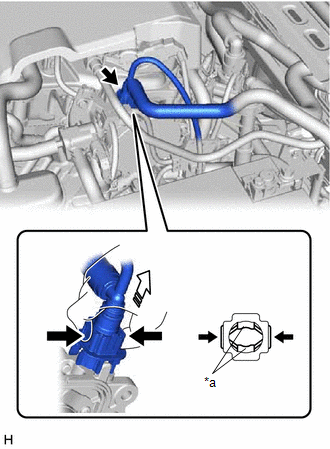
| *a | Retainer |
.png) | Pinch |
.png) | Pull off |
2. SEPARATE ENGINE WIRE
| (a) Disengage the 2 clamps to separate the engine wire. |
|
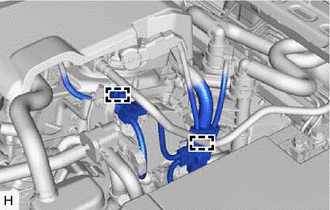
3. REMOVE VACUUM PUMP ASSEMBLY
| (a) Using an 8 mm socket wrench, remove the 3 bolts and vacuum pump assembly from the engine assembly. |
|
.png)
| (b) Remove the No. 1 vacuum pump O-ring from the vacuum pump assembly. |
|
.png)
READ NEXT:
 Components
COMPONENTS ILLUSTRATION *1 ENGINE WIRE *2 NO. 2 SURGE TANK STAY *3 EARTH WIRE - - Tightening torque for "Major areas involving basic vehicle performance such as moving/turni
Disassembly
DISASSEMBLY PROCEDURE 1. REMOVE END COVER (a) Using a T30 "TORX" socket wrench, remove the 5 screws and end cover. NOTICE:
Hold the pump so that the pump installation surface, fitting parts an
SEE MORE:
Hybrid Generator Circuit Current Out of Range (P1CA51D)
DTC SUMMARY MALFUNCTION DESCRIPTION This DTC indicates that current does not flow as commanded due to a generator output circuit malfunction. The cause of this malfunction may be one of the following: Area Main Malfunction Description Inside of inverter Inverter with converter assembly in
Front Side Marker Light Circuit
DESCRIPTION When the light control switch is in the tail or head position, the main body ECU (multiplex network body ECU) sends an illumination request signal to the headlight ECU sub-assembly to illuminate the front side marker lights. WIRING DIAGRAM for LED Type Turn Signal Light for Bulb Type Tu
© 2016-2026 Copyright www.lexguide.net
