
Lexus ES: Head restraints
Head restraints are provided for all seats.
WARNING
■Head restraint precautions Observe the following precautions regarding the head restraints. Failure to do so may result in death or serious injury.
- Use the head restraints designed for each respective seat.
- Adjust the head restraints to the correct position at all times.
- After adjusting the head restraints, push down on them and make sure they are locked in position.
- Do not drive with the head restraints removed.
Vertical adjustment
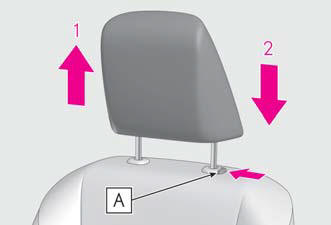
- Up
Pull the head restraints up. - Down
Push the head restraint down while pressing the lock release button A.
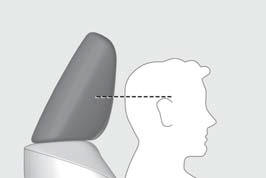
■Adjusting the height of the head restraints Make sure that the head restraints are adjusted so that the center of the head restraint is closest to the top of your ears.
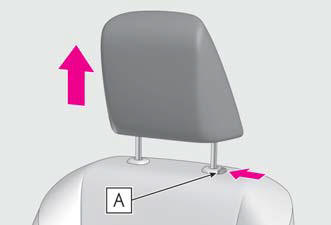
Removing the head restraints
Pull the head restraint up while pressing the lock release button A.
Front seats: If the head restraint touches the ceiling, making the removal difficult, change the seat height or angle.
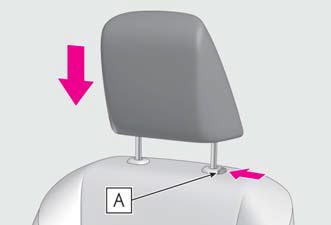
Installing the head restraints
Align the head restraint with the installation holes and push it down to the lock position.
Press and hold the lock release button A when lowering the head restraint.
READ NEXT:
 Steering wheel
Adjustment procedure
Manual adjustment type
1. Hold the steering wheel and pull
the lever down.
2. Adjust to the ideal position by moving
the steering wheel horizontally
and vertically.
Aft
Inside rear view mirror
The rear view mirror's position can
be adjusted to enable sufficient
confirmation of the rear view.
Adjusting the height of rear view
mirror
The height of the rear view mirror can
be adjusted to
SEE MORE:
System Diagram
SYSTEM DIAGRAM Communication Table Sender Receiver Signal Line Main Body ECU (Multiplex Network Body ECU) Outer Mirror Control ECU Assembly
IG signal
ACC signal
Outer mirror switch assembly signal
Mirror position request signal (memory and reactivation function)
Mirror
Removal
REMOVAL CAUTION / NOTICE / HINT HINT:
Use the same procedure for the RH side and LH side.
The following procedure is for the LH side.
PROCEDURE 1. REMOVE REAR WHEEL Click here 2. REMOVE REAR AXLE SHAFT NUT (a) Using SST and a hammer, release the staked part of the rear axle shaft nut. S
